
Plastic surgery
Breast reduction & uplift in Turkey: an honest guide
Medically reviewed by Dr. Mehmet Yılmaz
Quick answer
Breast reduction removes excess tissue, fat and skin to make heavy breasts smaller and lighter, easing symptoms like neck, back and shoulder pain; a breast uplift (mastopexy) reshapes and raises sagging breasts without much size change. Both are surgery that leaves permanent scars. At SaluVista, reduction and uplift starts from £3,360, confirmed by an itemised quote after assessment.
- Reduction is often about physical relief; uplift is about shape and position, and a reduction almost always includes an uplift.
- Uplift ≠ augmentation: an uplift lifts your own tissue; an augmentation adds volume with an implant. They can be combined.
- Every reduction and uplift leaves scars. A good surgeon shows you where they'll fall and never guarantees a specific look.
- From £3,360 (≈ €3,965) as a guide only. Your final price comes in a transparent, itemised quote after individual assessment.
In this guide
Heavy or sagging breasts can be a daily, physical burden. It's not just a matter of appearance. Grooves from bra straps, aching shoulders, skin irritation under the fold, and difficulty exercising are common reasons people look into breast reduction or an uplift. This guide explains what each operation actually does, how they differ from a breast augmentation, and what to expect from scars, recovery and cost, written to help you have a clear-headed conversation with a surgeon.
It's general information to help you prepare, not medical advice.
Reduction, uplift and augmentation — what's the difference?
These three operations are often confused. It's worth being precise. They change the breast in different ways, and choosing between them starts with what's actually bothering you: size, position, or volume.
Breast reduction
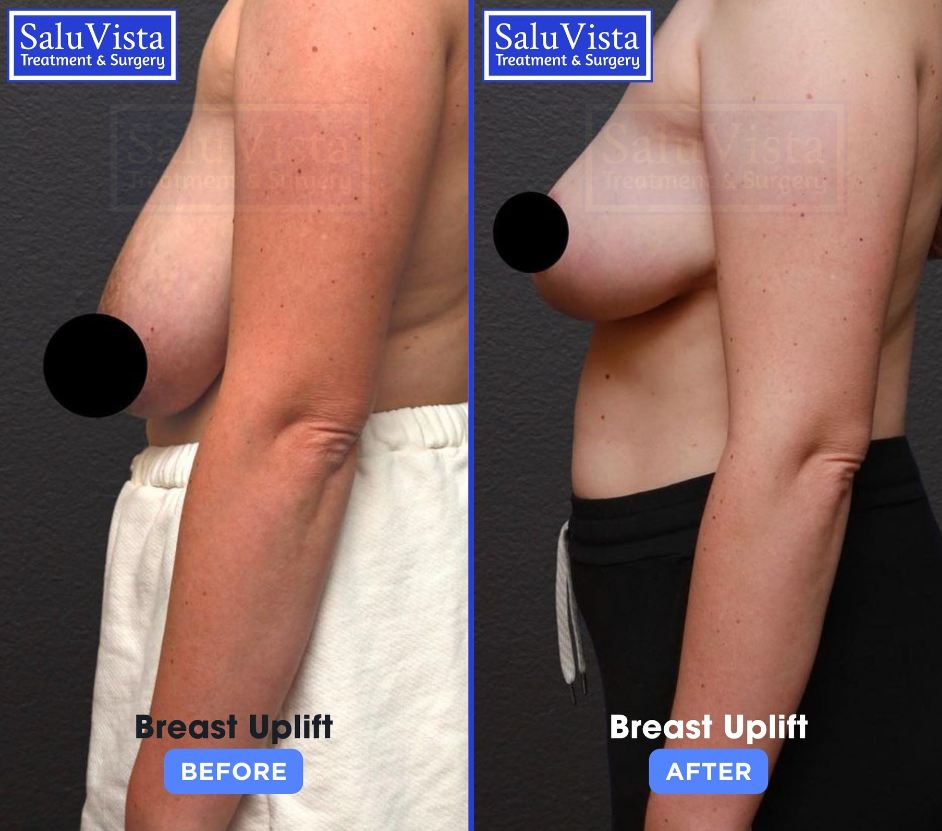
A breast reduction removes excess breast tissue, fat and skin to make large, heavy breasts smaller and lighter. Because removing tissue would otherwise leave the breast sitting low, a reduction almost always includes an uplift as part of the same operation, and the nipple is repositioned higher. For most people the goal is relief from physical symptoms as much as a change in shape.
Breast uplift (mastopexy)
A breast uplift, or mastopexy, reshapes and raises sagging breasts and lifts the nipple to a natural position. It doesn't significantly change the size. It's a good fit if you're broadly happy with your volume but not with drooping, which often follows weight loss, pregnancy or simply time. No implant is involved unless you choose to add one.
Breast augmentation (for contrast)
A breast augmentation adds volume using an implant. It makes breasts fuller or larger but does not, on its own, lift a breast that has dropped. If you want both more volume and a lift, an uplift can be combined with an implant: an augmentation and uplift. Our breast augmentation guide covers implants in detail.
If sagging is the concern, an implant alone won't fix it. And if weight is the concern, an implant makes it heavier, not lighter. Matching the operation to the actual problem is the whole game.
Relief from physical symptoms
Unlike many cosmetic procedures, breast reduction is frequently sought for physical, not aesthetic, reasons. Very large breasts can cause a cluster of symptoms that a reduction is designed to ease:
- Neck, back and shoulder pain from carrying the weight.
- Deep grooves where bra straps dig in.
- Skin irritation, rashes or infections in the fold beneath the breast.
- Difficulty exercising, finding clothes that fit, or sleeping comfortably.
- Discomfort or self-consciousness that affects daily life.
Because these symptoms are physical, many people describe reduction as one of the most satisfying operations they could have had, but that's an individual experience, not a promise. As the UK's NHS guidance on breast reduction notes, it's still major surgery with real risks that deserve careful thought, and it should never be undertaken lightly or under pressure.
A smaller change is sometimes the right one. A good surgeon may advise a more modest reduction than you first imagined, or an uplift alone rather than a reduction, if that better protects sensation, healing and long-term shape. Advising against surgery, or for less of it, is a sign of a surgeon working in your interest, not a lost sale.
Which procedure suits you
| Reduction | Uplift (mastopexy) | Augmentation | |
|---|---|---|---|
| Main goal | Smaller, lighter breasts | Raise & reshape sagging | More volume |
| Changes size? | Yes — smaller | No, or minimal | Yes — larger |
| Uses an implant? | No | Optional add-on | Yes |
| Often about | Physical symptom relief | Shape & position | Fullness & size |
| Includes a lift? | Yes, built in | Yes — that's the point | No (can be combined) |
| Scars | Anchor / lollipop pattern | Similar, sometimes less | Smaller, around fold/areola |
Many people considering these procedures after pregnancy or weight loss are really looking at a combination, which is where a mommy makeover (breast work plus body contouring) can come in. That's a conversation for assessment, where safety decides what can sensibly be combined in one session.
Scars, honestly
There is no version of breast reduction or uplift without scars. Anyone who tells you otherwise isn't being straight with you. What a skilled surgeon controls is where the scars fall and how well they're placed to fade and hide.
Where the scars go
- Around the areola — a circular scar at the edge of the darker skin.
- Vertically down from the areola to the crease (the "lollipop" pattern).
- Along the fold beneath the breast in larger reductions (the full "anchor" pattern).
These are placed where a bra and swimwear tend to cover them. Scars are usually red or raised at first and fade over roughly 12 to 18 months, but they are permanent and never disappear completely. How you scar depends partly on your skin and genetics, which is why no honest surgeon guarantees an exact result.
Ask your surgeon to draw the scar pattern on before you decide. Seeing exactly where the lines will sit is one of the most useful things you can do, and a surgeon confident in their work will happily show you.
The surgery & your surgeon
Breast reduction and uplift are performed under general anaesthetic, typically taking a few hours depending on the technique and how much tissue is involved, and during that time excess tissue and skin are removed or repositioned, the breast is reshaped, and the nipple is moved to a higher, natural position while keeping its blood and nerve supply wherever possible. Most patients stay one night and are seen for follow-up before travelling home.
At SaluVista, breast procedures are led by Assoc. Prof. Emre G., an academic plastic surgeon whose work spans facial aesthetics, rhinoplasty and body contouring, including post-bariatric reshaping after major weight loss. You speak with your surgeon before you travel; screening and booking happen in the app; and a qualified human surgeon makes the final decision on whether (and how) to operate. You can see the full plastic-surgery offering on our plastic surgery hub.
Turkey vs the UK. Lower prices in Turkey reflect lower running costs, not lower standards at a reputable clinic. But distance changes how you plan aftercare and follow-up. Our honest breakdown of the trade-offs is in plastic surgery in Turkey vs the UK.
Recovery, week by week
Recovery is staged, and rushing it is the main thing that goes wrong. As a general picture:
- First few days: soreness, swelling and bruising; you wear a supportive surgical bra and rest.
- Week 1–2: most people with a desk job return to work; you avoid lifting and reaching overhead.
- Weeks 4–6: heavy lifting and vigorous exercise are gradually reintroduced on your surgeon's say-so.
- Months 2–6: swelling continues to settle and the final shape emerges over several months; scars keep maturing for a year or more.
Everyone heals at their own pace, so treat this as a map rather than a timetable and follow your surgeon's specific instructions. Because SaluVista is set up for international patients, your aftercare plan is agreed before you fly home, with the clinic reachable through the app if you have questions during healing.
Cost in Turkey
At SaluVista, transparent guide pricing for breast reshaping is:
- Breast reduction & uplift — from £3,360 (≈ €3,965).
- Breast augmentation & uplift — from £3,360, with the implant an extra cost.
- Breast augmentation — from £2,680, with the implant an extra cost (see the augmentation guide).
These are "from" prices and a guide only. Your actual figure depends on your anatomy, the technique needed and the specifics of your case, and is confirmed in a transparent, itemised quote after an individual assessment with the surgeon, never a flat number promised before anyone has looked at you properly. Price should be the last thing you weigh, not the first, and it should never push you toward more surgery than you need.
Wondering whether a reduction, an uplift, or neither is right for you?
Share your symptoms, goals and a few details, and a specialist gives you an honest, personalised view, including if a smaller change or no surgery is the wiser call.
Get a free assessment →Frequently asked questions
What is the difference between a breast uplift and a breast reduction?
A breast uplift (mastopexy) reshapes and raises sagging breasts and repositions the nipple, without significantly changing size. A breast reduction removes excess breast tissue, fat and skin to make heavy breasts smaller and lighter, and almost always includes an uplift as part of the same operation. Reduction is often about relieving physical symptoms, while an uplift is usually about shape and position.
How much does breast reduction and uplift cost in Turkey?
At SaluVista, breast reduction and uplift starts from £3,360 (about €3,965) as a guide price, and a breast augmentation and uplift also starts from £3,360 with the implant an extra cost. These are from prices only; your final figure is confirmed in a transparent, itemised quote after an individual assessment with the surgeon.
Will breast reduction leave scars?
Yes. Breast reduction and uplift always leave permanent scars, most commonly around the areola and running vertically down to the crease, sometimes with a horizontal scar along the fold. Scars are placed where clothing and swimwear tend to cover them and usually fade over 12 to 18 months, but they never disappear completely. A responsible surgeon will show you exactly where scars will fall before you decide.
Do I need implants with a breast uplift?
Not necessarily. An uplift alone reshapes and raises the breast using your own tissue and is a good fit if you are happy with your size but not the sagging. If you also want more volume or fuller upper breasts, an uplift can be combined with an implant. The surgeon advises which approach suits your goals and anatomy, and sometimes recommends the simpler option.
How long is recovery after breast reduction or uplift?
Most people take one to two weeks off work for a desk job and wear a supportive surgical bra for several weeks. Heavy lifting and vigorous exercise are usually avoided for four to six weeks. Swelling settles gradually and the final shape emerges over several months. Everyone heals differently, so follow your surgeon's specific guidance rather than a fixed timetable.
Can breast reduction affect breastfeeding?
It can. Because reduction and uplift involve working around the nipple and glandular tissue, they may reduce or affect the ability to breastfeed in future. If you are planning to have children and breastfeed, tell your surgeon during assessment so it can be weighed in the decision about whether and when to operate.
This article is general information, not medical advice, and does not replace a consultation with a qualified doctor. Individual results, risks and recommendations vary, and no specific aesthetic outcome can be guaranteed. Always discuss your options and risks with a medical professional.